How Can Financial Institutions Ground LLMs for Real Operational Use?
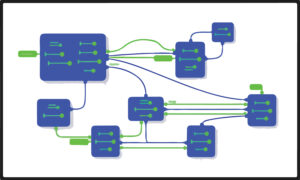
June 1, 2026An illustration of how probabilistic AI can be grounded inside deterministic financial operations

We’ve been taking a look at how AI is helping to operationalise the use of alternative data in investment management.
Our research shows the next frontier will be about more than finding new datasets – it will mean integrating them into production, side-by-side with traditional data, without reducing compliance or accuracy.
Today’s state – Machine Learning at the core
Over the past decade, ML has professionalised alternative data:
🟢 NLP cleans and structures vast news, filings, and sentiment feeds.
🟢 Computer vision extracts features from satellite imagery.
🟢 Anomaly detection flags patterns in IoT sensor data.
These techniques have made large-scale alternative data operationally viable – but they remain concentrated in specialist quant teams with heavy engineering pipelines.
The production reality
The real challenge lies in operationalising alternative data.
That means:
➤ Integrating it with traditional datasets.
➤ Mapping entities to master records and aligning timestamps to “as-of” truth.
➤ Embedding compliance restrictions into data pipelines.
➤ Building reproducible feature stores and governance for modelling.
These production steps determine whether an alternative dataset becomes a repeatable, high-value signal or remains an interesting one-off.
The next phase – Language Models + Agentic AI
☑️ Specialised language models enable user interaction with alt-data pipelines – defining collection processes, querying signals, and explaining results without code
☑️ Agentic AI orchestrates multiple agents across end-to-end workflows – sourcing → cleansing → feature engineering → backtesting → delivery
The Benefits:
This combination of AI and robust production workflows lowers barriers to entry and significantly compresses time-to-insight.
It moves alternative data from being a niche resource to a cross-firm capability.
📍 Our Market Map
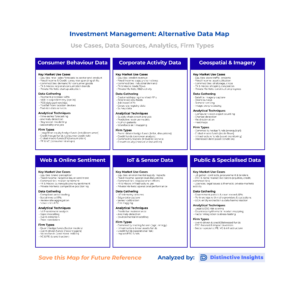
To put the space in context, we’ve mapped six major categories of alternative data in investment management – covering use cases, data gathering techniques, analytical approaches, and the types of firms most likely to apply them.
See the image for details.

 Back
Back

An illustration of how probabilistic AI can be grounded inside deterministic financial operations
Follow Distinctive Insights on LinkedIn and receive an invitation to subscribe to our newsletter.