How Can Financial Institutions Ground LLMs for Real Operational Use?
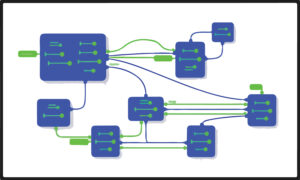
June 1, 2026An illustration of how probabilistic AI can be grounded inside deterministic financial operations

This article – AI and the “Existential Threat” to Financial Software – examines the growing narrative that artificial intelligence poses an existential threat to enterprise systems. We examine what this means in the context of capital markets, treasury and investment management technology. We focus on how agent-led orchestration, accelerated development and capability commoditisation interact with the historical stickiness of financial platforms.
Our analysis suggests that disruption in this sector will neither be instantaneous nor uniform. Short-term inertia, regulatory embedding and integration depth temper rapid change, while longer-term shifts in coordination patterns and development economics may gradually rebalance influence across the software stack. Understanding these layered dynamics is essential for assessing competitive positioning, investment strategy and architectural direction in financial institutions.
🟨 The Nature of AI Disruption
There is a growing sense that artificial intelligence poses an existential threat to traditional enterprise software. The argument is that AI will:
In capital markets, treasury and investment management, the implications of this narrative are complex.
These systems sit at the core of how capital is priced, liquidity is managed, risk is measured and transactions are executed. The impact of AI will depend as much on how sector-specific dynamics interact with broader technological shifts as on the technology itself. Generalised forecasts are therefore inherently uncertain.
🟦 The Historic Stickiness of Financial Systems
Enterprise software in these domains has historically endured because it is embedded in complex institutional processes. Whether that embedded complexity represents value or accumulated friction is open to debate. What is clear is that it creates stickiness: systems are difficult to replace without significant operational and regulatory consequences.
Analytics engines underpin pricing libraries, capital models, portfolio optimisation frameworks and liquidity stress testing. They are calibrated across market cycles, supported by validation frameworks and often subject to regulatory scrutiny. Replacing them requires rebuilding credibility inside live decision and reporting environments.
Workflow and integration systems operate even closer to execution. Trade capture platforms record legally binding positions. Collateral systems manage pledged assets. Treasury platforms control funding flows and liquidity buffers. Reconciliation engines ensure internal and external records align. These systems store execution state, enforce approvals and integrate deeply with financial infrastructure.
Full-stack platforms combine analytics and workflow into unified lifecycles. Front-to-back trading systems coordinate pricing, booking, lifecycle events and reporting. Over time, they become infrastructural – embedded across departments with significant switching costs.
This embedded position is the structural backdrop against which AI must be assessed.
🟪 How AI Introduces Pressure – and Opportunity
The disruption narrative rests on three broad themes: that AI will displace user interfaces, automate development and commoditise capabilities. Each force is real. The question is how it interacts with structural stickiness.
🔹 Theme 1: Displacing User Interfaces with Agent-Led Orchestration
The most visible shift is the move from navigating systems to instructing them.
Professionals in capital markets operate across pricing engines, risk dashboards, order management systems and treasury tools. User interfaces currently structure the sequence of action. Agents alter that dynamic. Instead of stepping through modules, a user can express intent – requesting an exposure view, stress scenario or funding analysis – and allow the agent to coordinate across systems.
If conversational interaction becomes standard, user interface differentiation narrows. The deeper issue is architectural. Does orchestration remain embedded within incumbent platforms, with agents layered into existing lifecycles? Or does coordination migrate outward into a horizontal layer spanning multiple systems?
If it shifts outward, previously functionally bundled capabilities may become more modular. If it is internalised, incumbents may absorb the interface shift without losing structural leverage. This will impact the ‘best-of-breed’ versus ‘single-integrated-platform’ debate.
🔹 Theme 2: Automating Development and Accelerating Replacement
AI-assisted development lowers the cost and time required to build software. Internal teams can prototype tools that once required vendor procurement. Specialist entrants can attack narrower problem sets with smaller engineering footprints.
This pressure is most immediate in peripheral layers – reporting modules, workflow extensions and analytical visualisation tools. Capabilities once considered too costly to replicate may now be rebuilt.
However, faster development does not eliminate institutional embedding. Replacing a validated capital model or a deeply integrated trade lifecycle system still involves regulatory scrutiny, operational migration and risk management.
AI changes the feasibility of replication at the edges. Whether that extends into core displacement depends on how deeply embedded the original system is.
🔹 Theme 3: Commoditising Bespoke Capability
AI also lowers the barrier to producing outputs that appear sophisticated.
Capabilities that once required specialist expertise – complex pricing views, tailored risk summaries, customised reporting – can increasingly be approximated through generative tools.
Where differentiation relied on presentation or surface complexity, pricing pressure may increase. In regulated environments, however, approximation is not always sufficient. Auditability, documentation and methodological transparency remain critical.
Commoditisation pressure is therefore uneven. It is strongest where complexity was cosmetic and weaker where complexity is embedded in validation and regulatory acceptance.
💡 AI Also Reduces Friction Which Will Increase Demand in Many Cases
The disruption narrative often assumes substitution – that AI replaces work and reduces system reliance.
Another dynamic is equally plausible. AI reduces friction in processes, making significantly more activity possible.
When this friction falls, demand on systems will expand significantly. Stress tests that were previously periodic may become more frequent. Exposure monitoring may shift from episodic to continuous. Operational processes may be automated more deeply.
In such cases, core engines may see increased invocation rather than decline.
🟩 How the Competitive Landscape May Evolve
Taken together, these forces suggest that disruption in financial software will not be instantaneous. The competitive landscape is more likely to evolve across distinct time horizons.
⏳Near to Medium-Term Horizon
In the near term, structural stickiness dominates.
Regulatory validation, operational migration risk and integration depth make wholesale replacement difficult. Systems that sit closest to capital measurement, transaction execution and system-of-record infrastructure benefit from embedded credibility and dependency.
AI-driven changes are therefore more likely to appear as augmentation rather than displacement. Conversational interfaces may layer on top of existing platforms. Development acceleration may lead to experimentation at the edges. Automation may increase system invocation rather than reduce it.
In this phase, incumbents retain meaningful structural advantage. Their challenge is less about survival and more about architectural adaptation – embedding AI capabilities in ways that reinforce rather than fragment their position.
New entrants, meanwhile, are more likely to gain traction through attachment: orchestration layers, focused analytics and operational automation tools that complement existing systems rather than attempt to replace them outright.
Disruption in this horizon is incremental, uneven and layered.
⏳Longer-Term Horizon
Over longer timeframes, structural dynamics compound.
Development economics continue to improve. Coordination patterns stabilise. Orchestration layers mature. Pricing transparency increases. What begins as peripheral augmentation can gradually reshape how value is distributed across the stack.
If agent-led coordination increasingly sits outside incumbent platforms, functional module bundling advantages may erode. If new architectures demonstrate reliability and integration maturity, embedding barriers may weaken. The distinction between core and peripheral layers may evolve.
In this horizon, the decisive factor becomes adaptation speed and architectural flexibility. Incumbents possess scale, distribution and embedded position. New entrants possess fewer legacy constraints and may be better aligned with emerging capabilities.
Over the longer term, outcomes will hinge on the ability to translate AI capabilities into structural integration across systems, workflows and commercial models.
The landscape is unlikely to resolve cleanly or uniformly. It will evolve across layers, use cases and time horizons, with different segments of the stack adjusting at different speeds.
The shift will be gradual – but the architectural consequences will ultimately prove permanent.

 Back
Back

An illustration of how probabilistic AI can be grounded inside deterministic financial operations
Follow Distinctive Insights on LinkedIn and receive an invitation to subscribe to our newsletter.