How Can Financial Institutions Ground LLMs for Real Operational Use?
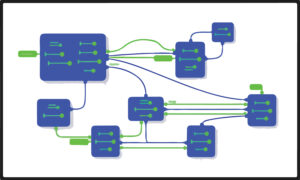
June 1, 2026An illustration of how probabilistic AI can be grounded inside deterministic financial operations

If the front office is where trades are born, the middle office and operations is where they are made coherent — captured, allocated, confirmed, and reconciled against a messy array of reference data, collateral terms, and settlement instructions. AI is increasingly being applied to this world of breaks, mismatches, and workflow bottlenecks.
At the same time, industry surveys suggest many firms are at breaking point with reconciliation data volumes, and are prioritising automation in matching and exception management.
This article positions the middle office and operations function as a “control fabric” for the trade lifecycle, where AI-supported information processing and workflow orchestration can reframe operational resilience — if the architecture is designed carefully.
Traditional post-trade operations treat breaks as operational noise to be cleared: teams compare systems and resolve mismatches through manual investigation. Case studies now show AI being used to ingest heterogeneous records, track positions through multiple books, and reduce false positives in reconciliation flows.
Vendors have launched platforms that combine AI and machine learning to improve matching and exception management, aiming to raise match rates and accelerate break resolution across asset classes.
Machine Learning models focus on pattern recognition across large, reconciled datasets. Language models can extract key terms from confirmations or emails and relate them to trade records.
When breaks are treated as a structured intelligence problem rather than a daily fire drill, operations leaders can articulate clearer design goals: reduce false positives, prioritise truly risky exceptions, and standardise the knowledge embedded in the best analysts’ judgement.
One design path is to embed AI within individual operational platforms — reconciliation tools, collateral systems, confirmations engines — each offering its own matching and classification logic. Another is to build an event-driven layer that consumes trade events from multiple systems, applies AI to the consolidated view, and then feeds outcomes back to the underlying platforms.
Embedded AI can be efficient for local pattern recognition but risks fragmentation of logic and governance. A cross-system control layer, by contrast, consolidates across reconciliations, allocations, and confirmations and lets institutions deploy agent-like components to route tasks and propose resolutions consistently.
The balance is not trivial: a cross-layer design promises better control and reuse but asks more of data engineering and operating model design.
As AI begins to assign work, not just analyse it, questions of control and accountability become sharper. Industry participants are discussing agentic AI for operations — including agents that pre-empt settlement failures, propose actions, and coordinate tasks across teams.
However, automation must not erode the ability of operations leaders to demonstrate control under regulatory scrutiny.
Architectures therefore need explicit points where human oversight is embedded into AI-orchestrated workflows. Models can propose classifications and likely root causes; agent-like components can suggest actions and assemble dossiers of evidence. But release of a settlement-critical change, or closure of a material break, should remain gated through human approval steps that are themselves captured in auditable logs.
Designing the middle office and operations as a control fabric means specifying which interventions can be safely automated, which require human sign-off, and how evidence generated by AI is presented in a way that supports — rather than overwhelms — supervisory review.
Middle office and operations architecture is moving from a patchwork of system-specific controls to something closer to a coordinated control environment, where AI helps surface, classify, and route issues across the trade lifecycle. Industry studies already point to reconciliation and exception management as priority areas for automation investment, driven by both cost and risk concerns.
The strategic question is whether to allow AI capabilities to accumulate inside individual platforms, or to invest in a cross-system intelligence and orchestration layer that can evolve with new asset classes and regulatory demands.
AI in the middle office and operations is less about replacing people and more about redesigning how workflow decisions are distributed across systems. The choices made here will determine how easily we can trust or challenge the operational story that accompanies each trade.

 Back
Back

An illustration of how probabilistic AI can be grounded inside deterministic financial operations
Follow Distinctive Insights on LinkedIn and receive an invitation to subscribe to our newsletter.