How Can Financial Institutions Ground LLMs for Real Operational Use?
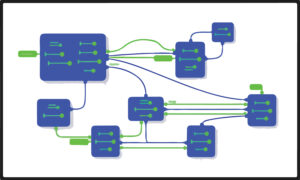
June 1, 2026An illustration of how probabilistic AI can be grounded inside deterministic financial operations

This article examines how AI can strengthen portfolio management controls – and why escalation logic, traceability, and governance design now determine whether risk is genuinely reduced or merely redistributed.
From a risk-reduction perspective, AI’s value in portfolio management lies in strengthening controls – but only if governance and accountability remain defensible.
Portfolio controls are judged by outcomes – fewer breaches, clearer audit trails, faster escalation. But they are built on routines: limit monitoring, guideline checks, exception handling, and documenting why decisions were taken. AI can strengthen these routines by making monitoring more consistent and escalation more timely.
The tension is that stronger controls are inseparable from governance burden. When AI influences what is flagged, suppressed, or escalated, it builds new accountabilities. The value case depends on whether improved discipline outweighs the added demands of explanation, auditability, and oversight.
AI can surface more signals – exposure drift, mandate edge cases, clusters of small exceptions. Control strength, however, depends on triage rather than volume.
Effective oversight requires separating what is genuinely material from what is noise, and identifying where rules are ambiguous enough to require human judgement. Without this separation, richer monitoring leads to alert fatigue, followed by informal threshold tuning that weakens defensibility.
The paradox is familiar: detection improves quickly, but discipline does not unless escalation logic is explicitly redesigned.
Once AI shapes escalation, it becomes inseparable from the control evidence itself. The question under scrutiny is no longer just whether a breach occurred, but why it was surfaced – or not.
Supervisory expectations increasingly emphasise that accountability remains with boards and senior management, regardless of tooling. In portfolio controls, this translates into clear ownership of AI-influenced processes and documented intent for how outputs are used. Without this clarity, AI can at the same time strengthen monitoring whilst weakening trust.
In practice, the hardest control challenge is not identifying issues. It is reconstructing the path from input data to alert to decision.
As AI influences exception handling, traceability becomes essential. Firms must be able to connect alerts – and silences – back to inputs, thresholds, and logic, and then link subsequent decisions to an evidentiary record. Without this, AI expands the audit surface instead of reducing risk.
AI can reduce overall control cost by preventing breaches and surprises. That only holds if governance overhead grows more slowly than control quality improves.
In practice, the most viable candidates are control tasks with stable definitions, repeatable inputs, and bounded outputs. Starting with ambiguous judgement zones creates review load without proportional benefit. Control improvement, like productivity, depends on disciplined task selection.
AI can strengthen portfolio controls, but it also changes the risk profile of oversight itself. The decisive factor is defensibility – whether escalation, suppression, and challenge remain explainable under scrutiny. Firms treating AI-enabled controls as governed components, with explicit ownership and traceability, are better positioned to capture risk-reduction benefits without drowning in governance overhead. Without that defensibility, AI improves detection metrics while increasing the institution’s control and accountability risk.

 Back
Back

An illustration of how probabilistic AI can be grounded inside deterministic financial operations
Follow Distinctive Insights on LinkedIn and receive an invitation to subscribe to our newsletter.