How Can Financial Institutions Ground LLMs for Real Operational Use?
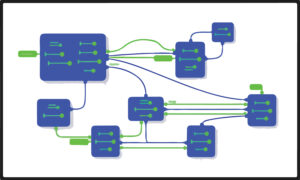
June 1, 2026An illustration of how probabilistic AI can be grounded inside deterministic financial operations

Foreign-exchange risk remains one of the most persistent sources of earnings volatility for global corporates and institutional flow businesses. What is new is the option to optimise hedging using machine learning models – often transformer architectures adapted from language processing to numerical forecasting – to predict FX-exposed cash flows, then routing those forecasts into bank execution rails.
Amid the current excitement around large language models, generative AI, and emerging agentic systems, it is worth remembering that some of the most tangible financial benefits are being realised through more classical machine learning approaches. Forecast-driven hedging sits squarely in that category – a pragmatic, data-driven use of AI that quietly improves cost efficiency and predictability.
Recent market pilots point to meaningful gains. A large airline’s online ticket flows saw materially lower hedging costs when forecast models were coupled with a bank’s fixed-rate programme – a signal that “good” hedging outcomes are shifting. Boards now face a strategic choice: retain static, policy-driven hedging or adopt forecast-driven, bank-integrated programmes that promise lower cost and tighter predictability – with new governance obligations attached.
What follows are four strategy themes to guide adoption of FX-exposure forecasting and hedge co-optimisation.
The shift is straightforward to describe and hard to execute: design hedges around predicted timing and size of exposures rather than around static layers or simple rolling forwards. In high-frequency businesses – e-commerce, travel, subscription models – ML models can generate forward views of receipts granular enough to shape tenor, sizing, and renewal cadence.
For corporate treasuries, this changes the objective function. It’s no longer “apply policy and accept slippage”; it becomes “minimise slippage and cost subject to accounting and risk constraints.” In capital-markets contexts, programme hedging for recurring flows can apply similar logic, aligning exposure forecasts with executable rails across multiple currencies.
There are three viable routes to deployment:
Signals in the market suggest momentum behind the partner and platform paths. One major bank has embedded dynamic hedging capabilities through acquisition; leading TMS vendors position forecasting, policy engines, and connectivity as a single operating fabric. Practitioner accounts show that when TMS and bank rails are tightly integrated, hedge accuracy improves and operational friction falls.
Strategy fails if governance fails. Two anchors matter.
Hedge accounting discipline. Under cash-flow hedging, forecast transactions must be highly probable and hedge effectiveness must be evidenced. Forecasts that stray from realised cash flows invite de-designation and P&L noise. Forecast-gated sizing, policy overrides, and prospective effectiveness checks need to be designed into the operating model from day one.
Model risk management. Regulators are signalling clear expectations around model governance in financial markets, and auditors are extending similar standards into corporate treasury practice. The same principles of validation, performance testing, and accountability therefore apply, even where a corporate is not directly supervised. AI forecast models drift; regimes break. Your playbook therefore includes stress-testing forecast / hedge pairs, sensitivity analysis around data shifts, and telemetry that flags when policy should tighten or switch to fallbacks.
Early wins live where data are dense and signals are strong. High-frequency receipt flows (airlines, e-commerce, app-based subscriptions) offer the best initial conditions. From there, extend to B2B receivables and other recurring flows once pipelines and controls prove themselves.
Decide upfront how success will be measured. A pragmatic KPI set:
The opportunity is to move from static hedging to a living system where forecasts, policies, and execution co-evolve. Market pilots demonstrate that, when model forecasts are wired to bank rails, treasuries can compress cost and improve predictability.
While industry attention gravitates toward LLMs, generative AI, and agentic workflows, traditional machine-learning continue to deliver concrete, measurable gains in financial operations. Forecast-driven FX hedging is a prime example – quietly transformative, accounting-safe, and operationally ready today.
The trend is to treat AI-powered FX hedging as a new operating model rather than a point tool. Choose your integration path deliberately, codify accounting-safe guardrails, and instrument the whole system with telemetry so forecast quality, policy, and economics are continuously co-optimised – and continuously auditable.

 Back
Back

An illustration of how probabilistic AI can be grounded inside deterministic financial operations
Follow Distinctive Insights on LinkedIn and receive an invitation to subscribe to our newsletter.