How Can Financial Institutions Ground LLMs for Real Operational Use?
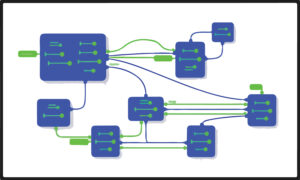
June 1, 2026An illustration of how probabilistic AI can be grounded inside deterministic financial operations

Front Office Machine Learning used to be “research output” – signals and forecasts that humans interpreted. Increasingly, it is being embedded into the workflow itself: market-state detection, pricing support, execution optimisation and intraday feedback. At that point, the model stops being an add-on and becomes part of the desk’s decision loop.
That matters because market-facing systems scale differently from back-office automation. They run on streaming data, interact with one another at speed, and can influence market dynamics even when each local decision looks rational. The design question has therefore moved on: not “is the prediction good?”, but “what is the model permitted to change, when, and with what brakes?”
Many desks now deploy ML in two places. Upstream, it turns noisy market data into usable context – regime classification, state detection, anomaly flags. Downstream, it sits closer to action – predicting short-horizon outcomes and tuning execution parameters as conditions change.
Both deploy Machine Learning, but the pattern differs. Upstream models reshape information-processing; downstream models create real-time optimisation loops fed by streaming features and judged by realised outcomes (fills, slippage, impact). Architecturally, that pushes firms towards shared feature definitions, versioned models, and a clean separation between what is observed and what is decided. Without that, backtests are hard to trust and incidents are hard to diagnose.
As ML becomes part of the loop, the key tension is performance versus fragility. Adaptive models can improve execution in calm markets; in stress, similar models can lean the same way and amplify shocks.
The practical architectural response is to embed control points into the loop:
These controls force an operating model. Someone must own model behaviour on the desk; someone must own production reliability; and escalation must work at market speed. Otherwise the system becomes both opaque and ungovernable.
Scaling ML usually produces shared infrastructure: feature libraries, registries, reusable templates and standard monitoring. It reduces duplication – and it can also create correlation risk.
If many desks converge on similar inputs and similar optimisation logic, market behaviour can become more correlated. The risk is not literal code reuse; it is standardising how “market context” is represented and how actions are tuned. Under stress, that homogeneity matters.
A useful architectural question is therefore: where does controlled differentiation live? Sometimes it is in unique data and labelling. Sometimes it is in how regimes are defined and features are normalised across conditions. And sometimes it is in loop design – update cadence, bounds on action, and the triggers that pull a human back into the chain.
Language Models and agent-like tooling are starting to wrap around this fabric – accelerating documentation, testing, deployment and rollback. They do not replace the ML loop, but they increase its velocity, which makes the embedded control points above more important, not less.
Front-office ML is shifting from better prediction to embedded decisioning. Once that happens, architecture becomes the main lever for both performance and stability – because it determines what can change, how fast, and how failure is contained.
Supervisors and industry bodies are increasingly focused on correlated behaviour, opacity and third-party dependencies. Desks that scale safely will be those that treat ML as a decision engine with explicit permissions, bounded autonomy and rapid, accountable intervention.

 Back
Back

An illustration of how probabilistic AI can be grounded inside deterministic financial operations
Follow Distinctive Insights on LinkedIn and receive an invitation to subscribe to our newsletter.