How Can Financial Institutions Ground LLMs for Real Operational Use?
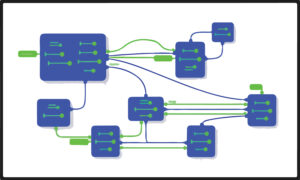
June 1, 2026An illustration of how probabilistic AI can be grounded inside deterministic financial operations

In the latest in article exploring AI innovations in Investment Management we look at the challenges of applying AI in opaque private credit markets.
This short article in our Distinctive Insights Intelligence Vault series looks into this important theme and highlights the latest developments.
Our aim in publishing this content is to help finance professionals further understand how artificial intelligence and data analytics are being applied to support key business processes within financial institutions.
AI is transforming many areas of Investment Management — but Private Credit can present a particularly difficult challenge. We’ve been looking into some of the market dynamics and developments in this area – in particular how data opacity challenges investment research, due diligence and portfolio monitoring.
In this market, data opacity is often structural.
🔹 Highly relationship-driven — deals sourced and transacted through private networks
🔹 Bespoke structures, documentation and terms—covenants, guarantees, collateral and security can vary deal-to-deal,
🔹 Private borrower data — often informal, incomplete, and off-market
🔹Untransparent corporate structures – crossholdings and corporate groups are difficult to identify for both borrowers and sponsors
🔹 Sparse public signals — limited filings, press coverage, or ratings
For AI tools, this can present significant obstacles.
Many AI applications in Investment Management succeed because they can draw on:
🔹 Large volumes of structured or semi-structured data
🔹 Public company filings
🔹 Financial statements
🔹 News and research feeds
🔹 Transaction data
In Private Credit, by contrast, much of the valuable information typically resides in:
🔹 CRM notes and internal relationship intelligence
🔹 Unstructured legal documents
🔹 Internal reports and deal memos
🔹 Email trails and proprietary networks
The data is fragmented and incomplete. Off-the-shelf models trained on public market data can struggle to deliver useful outputs in this context.
Different design components are often needed.
Private Credit still typically leverages a hybrid data architecture (combining public + client specific data) but the emphasis leans more towards the client specific data than in other investment management sectors.
Success can therefore depend on:
🔹 Ingesting and structuring proprietary internal data
🔹 Using knowledge graphs to map market networks and relationships
🔹 Operating effectively with incomplete and uneven data
🔹 Supporting human-in-the-loop workflows
Encouragingly, we are seeing vendors and innovators rising to these challenges — building AI solutions that are flexible, relationship-aware, and designed for the realities of Private Credit.

 Back
Back

An illustration of how probabilistic AI can be grounded inside deterministic financial operations
Follow Distinctive Insights on LinkedIn and receive an invitation to subscribe to our newsletter.