How Can Financial Institutions Ground LLMs for Real Operational Use?
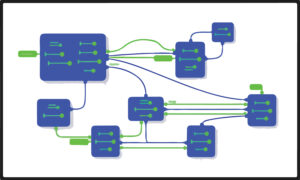
June 1, 2026An illustration of how probabilistic AI can be grounded inside deterministic financial operations

This article examines where AI genuinely increases portfolio management productivity – and why most gains depend on task design, review discipline, and information boundaries rather than model capability.
Viewed through a productivity lens, AI’s impact on portfolio management is less about automating judgement and more about redesigning how recurring decision-support work is produced and reviewed.
AI is beginning to change portfolio management in a practical, unglamorous way. The most visible impact is not automation of investment judgement, but compression of recurring decision-support work – daily monitoring notes, weekly review packs, mandate commentary, and committee preparation. These activities absorb time because they repeat, not because they are inherently complex.
The productivity opportunity is real, but conditional. Cost take-out only becomes durable when firms decide which tasks can be standardised or removed without weakening judgement. Simply adding AI tools on top of existing routines increases activity without reducing effort. The real implementation challenge is redesigning work so throughput rises while decision integrity remains stable.
Portfolio workflows often bundle together tasks that appear similar on a schedule but behave very differently in practice. Summarising market movements, explaining mandate alignment, and framing investment recommendations may all sit inside the same pack, yet they carry different judgement weight and governance expectations.
Effective productivity programmes begin by disentangling recurring work into distinct categories: extracting key changes, synthesising drivers, comparing positions against benchmarks or constraints, and explaining decisions or non-decisions. Only some of these can be compressed reliably. Treating them as a single category called “reporting” obscures where effort can genuinely be reduced.
Early gains usually come from standardising low-to-medium judgement tasks that repeat across portfolios, rather than from touching the most sensitive explanations.
Human review is often framed purely as a safeguard. In practice, it is also a throughput constraint. If every AI-generated output is rewritten line by line, productivity evaporates. If outputs are accepted uncritically, decision quality erodes.
What matters is how review is designed around specific work objects. Daily monitoring notes may only require sampling and sense-checking. Weekly packs often benefit from structure-focused review rather than sentence-level edits. Committee materials still demand evidence-based scrutiny. When review expectations are not differentiated, AI adds friction instead of removing it.
The productivity lesson is straightforward: review discipline must be redesigned alongside generation, or gains will not persist.
Portfolio Management productivity is constrained as much by information access as by technology. The most valuable context – internal research notes, position rationales, restricted market colour – is often sensitive.
Where AI tools sit outside these boundaries, teams revert to manual synthesis and productivity gains collapse. Where boundaries are clear, trusted, and operationally workable, compression becomes sustainable. The decisive factor is whether AI sits inside the information perimeter that actually matters for portfolio decisions.
The final trap is measurement. Tracking minutes saved drafting commentary encourages superficial substitution. A more credible lens is cost-of-decision support – how many decision moments a team can cover at acceptable quality and governance cost.
Metrics such as pack cycle time, rework after senior challenge, and error-and-omission incidents are more revealing than writing speed alone. Without this shift, productivity initiatives tend to plateau quickly.
AI-driven productivity in portfolio management is bankable only when treated as workflow redesign rather than tool adoption. The near-term prize is compressing recurring synthesis while protecting judgement. The risk is accidental overuse that increases review load and slows decisions. Our research suggests firms that explicitly choose which work objects to standardise – and redesign review accordingly – are far more likely to realise durable operating leverage. In this sense, productivity gains are measured not in faster writing, but in sustained reductions in decision-support effort per portfolio without loss of control.
 Back
Back

An illustration of how probabilistic AI can be grounded inside deterministic financial operations
Follow Distinctive Insights on LinkedIn and receive an invitation to subscribe to our newsletter.