How Can Financial Institutions Ground LLMs for Real Operational Use?
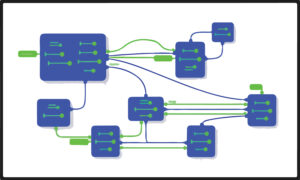
June 1, 2026An illustration of how probabilistic AI can be grounded inside deterministic financial operations

Post-trade operations thrive on certainty – AI models do not. Capital markets expect trades to enrich, match, reconcile and settle on deterministic rails. Generative models, by design, can give different answers to the same question, and their behaviour can shift with model updates.
Regulators have already made the direction clear: firms remain responsible for outcomes, with robust testing, oversight and record-keeping. Standards bodies emphasise lifecycle test, evaluation, verification and validation (TEVV) – and traceability end to end. At the same time, front-line adoption is underway. When a market institution uses a conversational system to enhance post-trade client services, the architecture must shoulder a higher bar for serving, observability and fallbacks.
This piece sets out four architectural patterns that create an “envelope of determinism” around non-deterministic models in post-trade and adjacent operations.
Architecturally, non-determinism at serving time comes from stochastic decoding, backend changes and model updates. The platform should therefore pin model versions, watch for backend drift via a system fingerprint, and force outputs into strict, machine-checkable formats.
In trade enrichment and matching – where counterparty, instrument and allocation fields are normalised before matching – enforcing a fixed data structure (‘schema-first’) makes downstream behaviour predictable even when an upstream model is probabilistic. Think of the model as a suggestion engine behind a deterministic contract: a pinned snapshot plus a fingerprinted runtime and force outputs into strict, machine-checkable formats such as JSON Schema.
The benefit is repeatability and faster incident triage. The cost is stricter change control, occasional retries to satisfy schemas, and less room for “creative” answers. The practical conclusion: treat the LLM as a probabilistic core behind a hard interface, and design that interface as you would any other critical service boundary.
If you can’t replay it, you don’t control it. Architecturally, that means capturing inputs, prompts, parameters, model identity, system fingerprints, tool calls and outputs as first-class telemetry. Build golden-set replays, offline regression suites and online monitors for drift and output conformance into the pipeline from day one – not as an afterthought.
A good example is reconciliations and exception management, where teams predict settlement fails, route exceptions and prove control effectiveness to audit. Industry examples in post-trade risk reduction have shown the value of telemetry-rich models: performance can be measured, challenged and improved only when decisions are reproducible.
The payoff is regulator-ready audit trails and faster investigations. The trade-off is storage, data governance (including any personal information within logs), and the engineering effort to maintain replay datasets. The architectural habit being adopted is to build observability in by design – not as a by-product.
Once models are constrained and observed, the next architectural layer is choreography – ensuring actions align with confidence.
Non-deterministic systems need choreography, not blind trust. Architecturally, create an action-gating layer. High-impact operations route to human review; policy or guardrail triggers block and escalate; and deterministic fallbacks apply if outputs fail validation or confidence checks.
In client service and post-trade enquiries – allocations clarifications, SSI questions, margin call details – wrong answers create booking or settlement risk. Human review with concise, explainable summaries keeps accountability with supervisors, while deterministic, rule-based fallbacks ensure the workflow can still progress when the model’s suggestion is rejected.
You gain risk reduction and clear supervisory records; you pay in latency and staffing, plus some UI/UX work to make reviews efficient. Treat the end-to-end flow as a workflow engine where models propose and supervised, deterministic steps commit.
Small changes move outcomes. Architecturally, version every artefact that can change behaviour: prompts, retrieval indices, datasets, models and decoding parameters. Enforce approvals and keep a reproducible bundle for audits – the system fingerprint alongside an artefact manifest. Model registries and deployment descriptors provide the spine; drift monitors tell you when to cut a new version.
Collateral and margin management is a good illustration. LLM-assisted extraction from CSAs and client communications can alter margin calls if prompts or retrieval corpora shift. Treat these components as code – versioned, reviewed and released through the same gates as models.
This provides traceability, rollback and safer vendor/model upgrades. The compromise is added process discipline – and, at times, a slower release cadence.
Across all four patterns, the design intent is consistent: where the core is probabilistic, enforce determinism at the boundary. Pinned versions and fingerprints. Strict output contracts. Telemetry-first observability with replayability built in. Human-gated commits and deterministic fallbacks. This is aligned with regulatory direction and with what platform providers explicitly state about non-determinism.
As client-facing post-trade use cases move from pilots to production, expect supervisors to sharpen expectations for replayability and lineage, and for the industry to converge on schema-first serving with mandatory fingerprint logging. Our research points to a simple architecture takeaway for financial services leaders: make determinism a property of your platform and design every AI service so an auditor can reconstruct what happened and why, on demand.
In time, this architecture of determinism will become the core compliance fabric for AI-driven financial markets operations – the new backbone of digital market integrity.

 Back
Back

An illustration of how probabilistic AI can be grounded inside deterministic financial operations
Follow Distinctive Insights on LinkedIn and receive an invitation to subscribe to our newsletter.