The Missing Layer in Enterprise AI Adoption in Financial Services
March 20, 2026Between individual usage and autonomous systems, a critical layer is driving real AI value.

Artificial intelligence is widely described as a productivity technology, expected to allow organisations to complete existing tasks faster, at lower cost, and with fewer resources.
Our research suggests that is directionally correct, but incomplete.
An alternative idea is that instead of simply accelerating existing work, AI lowers the marginal cost of analysis and execution. Teams start to undertake activities that were previously impractical or uneconomic to sustain. The outcome is often not less work. It is broader coverage, greater variation in analysis, and deeper support for decision making.
Software engineering offers an early illustration. AI assisted development has frequently expanded experimentation, widened feature sets, and encouraged systematic backlog remediation. Straightforward reductions in developer workload have been less common. Engineers spend less time writing individual lines of code, yet they ship more releases, run more iterations, and are asked to solve a wider range of problems.
We see the same feature emerging in Financial Services business process re-engineering. Is AI primarily an efficiency lever, or does it expand the scope and depth of work institutions decide to perform? And what does that shift mean for the people carrying out that work?
When the marginal cost of analysis or execution declines, organisations sometimes complete the same workload more efficiently. In practice, they often expand activity instead.
Backlogs that once remained untouched become viable; monitoring widens; scenario generation multiplies; exploratory analysis becomes routine; all because the effort required to sustain these activities falls sharply.
Financial Services is especially sensitive to this effect because additional analysis frequently has tangible value – more evidence reduces downside exposure; broader monitoring surfaces emerging risks earlier; deeper scenario testing strengthens confidence around high-stakes decisions.
Historically, these activities were constrained by cost, operational complexity, and the labour required to maintain them.
AI relaxes those constraints. Producing analysis, narrative, and structured output becomes cheaper, which makes new investigations and additional courses of action commercially realistic. Productivity, in this environment, shifts away from speed alone and begins to reshape what institutions consider feasible to undertake.
Expanded activity, however, is not guaranteed.
Financial Services processes operate within several structural constraints that can prevent productivity gains from translating into demand for additional work.
These constraints explain why AI productivity sometimes does simply reduce workload in a way that might be predicted by the most basic efficiency argument.
A useful distinction is between demand-capped and demand-elastic activity.
In demand-capped work, output cannot grow materially. Regulatory timelines, governance structures, operational throughput limits, or simple value saturation define how much work is required. Automation in these environments often reduces workload or frees capacity for redeployment because the organisation has limited ability to absorb additional output.
In demand-elastic work, lower analytical cost stimulates demand. Coverage expands. Variations multiply. Edge cases receive attention that previously seemed disproportionate to their probability. Here, AI rarely eliminates work. It redistributes effort toward review, prioritisation, synthesis, and judgement.
The critical determinant is not the technology itself. Workload outcomes tend to follow the nature of demand constraints surrounding each activity.
Viewed through this lens, AI productivity tends to appear in three overlapping forms.
Volume expansion occurs when lower analytical cost stimulates additional activity. Institutions monitor more signals, investigate more cases, automate more processes, or extend research coverage. This pattern is most visible where latent analytical backlogs already exist and demand for insight responds quickly to falling costs.
Depth expansion arises when decision frequency remains stable while analytical richness increases. AI enables broader scenario testing, layered evidence construction, and more sophisticated exploration of trade-offs. The number of decisions stays constant, but their analytical foundations strengthen.
Speed improvement reflects situations where identical outputs are delivered faster. Incident response, dispute resolution, exception handling, and regulatory preparation often sit here, where volume is fixed yet response time carries real value.
These dynamics frequently coexist. Even within a single workflow, different stages can exhibit distinct combinations of all three.
Credit risk monitoring illustrates the interaction clearly. AI is unlikely to increase the number of counterparties an institution manages. It can, however, expand the range of indicators tracked per counterparty, support more granular and frequent scenario testing, and compress escalation timelines once thresholds are breached. The productivity gain is substantial, yet it does not resolve into a single measurable outcome of either time saved or more done.
This is often why the benefits from AI transformation across Financial Services rarely feel linear. Gains in one process often generate new expectations, controls, or review requirements elsewhere.
This leads directly to the human dimension.
If AI expands what institutions can analyse and execute, the impact on individual workload becomes ambiguous. Roles rarely disappear immediately. Expectations tend to evolve instead.
Organisational capability frequently expands faster than available time. Production becomes quicker, but demand grows alongside it. Output volumes increase, while review, validation, and interpretive responsibility expand in parallel. Professionals spend less time producing artefacts and more time assessing their reliability, prioritising outcomes, and standing behind the final decision.
At this stage, the argument does not depend on making a prediction, but rather it invites reflection.
Is the core output of your role constrained or elastic?
If analysis became ten times cheaper, would your organisation want more of it?

 Back
Back
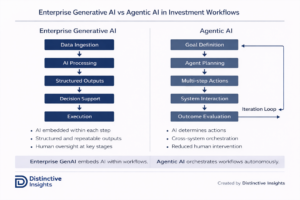
Between individual usage and autonomous systems, a critical layer is driving real AI value.
Follow Distinctive Insights on LinkedIn and receive an invitation to subscribe to our newsletter.