How Can Financial Institutions Ground LLMs for Real Operational Use?
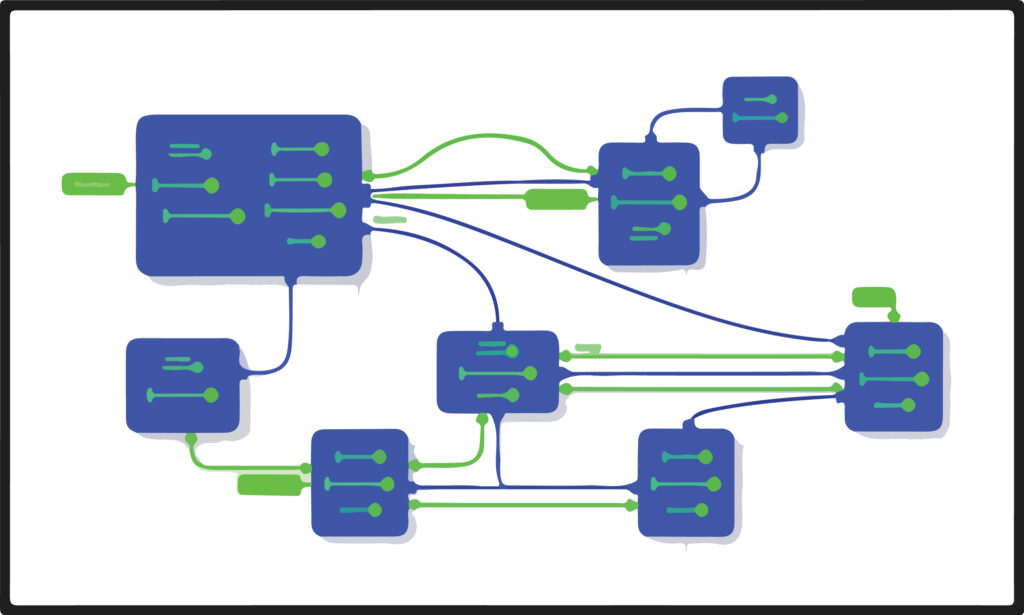
June 1, 2026An illustration of how probabilistic AI can be grounded inside deterministic financial operations

🟨 In Summary
🧩 “AI-native” is becoming an increasingly common term in financial services vendor positioning, but the term is opaque and even misleading for many people
🧩 To unpack this, we suggest that the distinction between functional AI capabilities and technical AI capabilities is critical to distinguish
🧩 Functional AI asks whether AI should execute the business capability itself
🧩 Technical AI asks whether the platform is built to operate in an AI-enabled enterprise environment
🧩 The key evaluation question is not simply whether a platform is AI-native, but precisely how
🟦 What “AI-Native” Really Means in Financial Services
“AI-native” is becoming one of the more commonly used terms in financial services vendor technology positioning.
It is used to describe platforms with embedded copilots, AI-enhanced SaaS products, agentic workflow tools, conversational interfaces, autonomous operating models and vendors founded during the generative AI cycle. These are clearly not all the same thing.
Treating all of these as “AI-native” obscures an important architectural distinction: let’s call it functional AI versus technical AI. This distinction is central to understanding how AI-native platforms are likely to evolve in financial services.
🟦 Functional AI vs Technical AI
The question in the functional box is whether AI should perform, mediate or control the business function itself.
This is a workflow-specific question and the answer will, quite rightly, differ on a case-by-case basis.
Some activities are well suited to AI because they involve interpretation, prediction, synthesis or coordination.
Other activities, less so. Accounting integrity, settlement finality, payment execution, cash movement authority, regulatory calculation, and many other processes often require deterministic execution. In these areas, repeatability, auditability and formal authority matter more than adaptive reasoning.
This means that a platform does not become outdated – or not ‘AI-native’ – simply because deterministic systems remain appropriate. In many financial services workflows, deterministic execution is not a limitation. It is the operational requirement.
In the technical box, the question is slightly different: is the platform built so it can work effectively in an AI-enabled enterprise environment?
This does not mean that AI has to take over the business logic of the system. A platform may still rely on explicit rules, controlled calculations and governed execution steps. It may remain deterministic in the way it processes transactions, records positions, calculates exposures or applies approvals.
But around that core, the technical architecture may need to change. The platform may need to make its data easier for AI tools to understand, expose functions through well-designed APIs, provide clear metadata about processes and controls, support automated monitoring, and allow AI agents or copilots to interact with it safely.
In other words, a system can remain controlled and rule-based in the business functions it performs, while still becoming more AI-ready in the way it is built, connected, monitored and operated.
The key point is that the use of AI in the functional domain and the use of AI in the technical domain are conceptually distinct factors. A system can use little AI inside the business function but still become more technically AI-native. Equally, a system can have highly visible functional AI features while not built to operate inside an AI-mediated enterprise environment.
🟦 Why this Matters in Financial Services
Financial services makes this distinction especially important because many workflows have low tolerance for uncontrolled ambiguity.
Errors can create failed settlement, incorrect books and records, liquidity pressure, misreported exposures, regulatory breaches or legal disputes. Processes often depend on reconciliation, delegated authority, audit evidence, model governance and operational resilience.
This does not make AI less relevant, but it does change how we think about where AI should sit.
The likely trajectory is not fully probabilistic operational cores. It is deterministic foundations surrounded by increasingly intelligent interpretation, monitoring, orchestration and governance layers.
Machine learning may support prediction and anomaly detection. LLMs may support interpretation, explanation and documentation. Agentic AI may coordinate workflow steps across tools and systems. But deterministic systems will often continue to preserve official records, calculations, approvals, execution controls and compliance evidence.
The central design question is therefore not simply: “Is this platform AI-native?”
It is more precise to ask: exactly how is it AI-native?
🟨 Implications for Evaluating Platforms
This distinction matters when evaluating financial services systems – whether incumbent platforms or new entrants.
The first question is functional.
Where is AI actually performing, mediating or influencing the business workflow – and is that appropriate given the process risk, control requirement and decision context?
This helps avoid two mistakes. One is assuming that every function should become AI-driven. The other is assuming that a platform is less advanced simply because it preserves deterministic execution where deterministic execution is required.
The second question is technical.
Is the platform architected for an AI-mediated operating environment – with the semantic, integration, observability, orchestration and governance capabilities needed for future enterprise architecture?
This helps distinguish surface-level AI enhancement from deeper architectural readiness. A legacy platform with a copilot is not necessarily technically AI-native. A new entrant with highly visible AI features is not automatically suitable for governed financial services workflows. Conversely, a deterministic system with strong semantic access, orchestration readiness, machine-readable controls and clear governance boundaries may be moving towards technical AI-nativeness in a more meaningful way.
The most advanced financial services platforms may not be those that make every function AI-driven. They may be those that preserve deterministic execution where it is required, while becoming technically AI-native around the core.
When evaluating financial services systems – incumbents and new entrants alike – this is a key distinction to hold on to.
 Back
Back

An illustration of how probabilistic AI can be grounded inside deterministic financial operations
Follow Distinctive Insights on LinkedIn and receive an invitation to subscribe to our newsletter.