How Can Financial Institutions Ground LLMs for Real Operational Use?
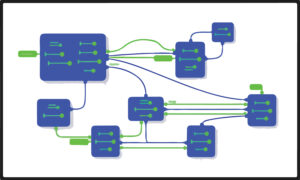
June 1, 2026An illustration of how probabilistic AI can be grounded inside deterministic financial operations

This article explores how AI accelerates portfolio decision cycles – and why decision rights, delegation, and cadence-aware governance determine whether speed becomes advantage or instability.
In agility terms, AI’s impact on portfolio management is less about faster analysis and more about whether decision rights and governance can operate at higher cadence.
AI is accelerating the portfolio decision loop. Market interpretation is quicker, scenarios are generated faster, and rebalancing options surface sooner. The temptation is to equate speed with advantage.
The strategic risk is that higher cadence increases the number of decision moments without redefining who owns them. When speed rises but decision rights remain unchanged, accountability fragments and explanations weaken. Agility becomes noise rather than advantage.
Portfolio governance has traditionally been built around periodic review – weekly meetings, monthly forums, scheduled committees. AI compresses analysis and encourages more frequent action, even when governance remains tied to the calendar.
Policy research increasingly treats speed of action as the critical risk variable. Faster intervention without redesigned oversight creates new failure modes, particularly when actions cluster. For portfolio leaders, the implication is clear: cadence changes require governance redesign, not just faster tools.
Scenario generation accelerates easily. The harder problem is deciding which scenarios matter.
When analysis becomes cheap, organisations risk producing more narratives, more updates, and more micro-decisions without clearer triggers for action. Strategic clarity depends on defining which scenario families genuinely drive decisions and explicitly relegating the rest to context.
Without that discipline, speed inflates activity rather than sharpening judgement.
At higher cadence, similarity matters more. Shared data, common vendors, and comparable optimisation logic mean that faster can also mean faster together.
Central bank analysis has highlighted the risk of herding and procyclicality where AI tools and inputs converge. For portfolio management teams, agility therefore cannot mean reacting first at all costs. It must mean reacting coherently, with defensible rationale even when peers move in similar ways.
If speed is to translate into advantage, decision rights must be redesigned deliberately. That usually means delegating narrow classes of action closer to the workflow, reserving high-impact changes for slower forums, and setting explicit constraints to prevent churn.
Where delegation does not evolve, bottlenecks expand. Where it expands without constraint, accountability dissolves. Speed exposes weaknesses in decision design more quickly than any other change.
AI shortens the distance from market change to portfolio action. That only creates agility when authority, delegation, and escalation are designed to operate at higher cadence. In practice, speed exposes weak decision design faster than it creates advantage. Firms that clarify where discretion lives, which actions can be taken without committee intervention, and how accountability is preserved are better positioned to act decisively under pressure. Where those foundations are absent, faster tools amplify motion rather than responsiveness.
 Back
Back

An illustration of how probabilistic AI can be grounded inside deterministic financial operations
Follow Distinctive Insights on LinkedIn and receive an invitation to subscribe to our newsletter.