How Can Financial Institutions Ground LLMs for Real Operational Use?
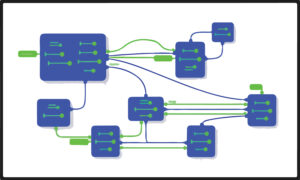
June 1, 2026An illustration of how probabilistic AI can be grounded inside deterministic financial operations

Large language models are clearly powerful, but on their own are not sufficiently reliable for core financial operations as these systems depend heavily on verifiable outcomes, auditability, and governed execution.
So how can the undeniable power of LLMs be leveraged within these processes?
For many, the answer lies in surrounding LLMs with semantic models, knowledge graphs, retrieval systems, and deterministic governance frameworks.
This sounds complicated to non-technical audiences – so let’s take a look at how these concepts might translate into business operational processes, using a simplified operational example.
Imagine a large USD settlement fails because an incoming payment is delayed.
🟦 First, the systems need to identify what has happened
The operational systems first identify that a settlement failure has occurred.
The event may initially appear as something like:
Event: USD settlement failed
Trade ID: T123
Currency: USD
Reason: insufficient_funds
At this stage, this is simply deterministic operational infrastructure identifying that a controlled workflow state has changed.
The settlement engine remains the authoritative system of record.
🟦 Next, the event needs to be translated into operational meaning
The raw event code itself does not yet fully explain the operational situation.
The system therefore needs to translate technical event codes into business meaning.
For example, the reason code ‘insufficient_funds’ might operationally correspond to a more meaningful ‘Liquidity-related settlement failure’.
This translation might be performed through rules-based mapping, NLP style classification, or other related methods. We won’t invoke an LLM at this stage.
(Technical concept: Semantic Mapping)
🟦 The system next needs to understand how the operational environment fits together
At this point, in order to move forward into practical action, the system needs to understand what else operationally connects to the failed settlement.
For example:
To do this, the system first needs a structured understanding of how different operational concepts relate to one another.
For example:
(Technical concept: Ontology Model)
In simple terms, the ontology acts as a structured map of how operational concepts fit together across the organisation.
The system can then start identifying the actual live relationships associated with this specific failed settlement.
For example:
(Technical concept: Knowledge Graph Traversal)
Here, the knowledge graph represents the live network of connected operational relationships across the enterprise.
Without these layers, the failed settlement remains an isolated operational alert rather than a broader operational situation.
These mechanisms are typically implemented using structured metadata, relationship mappings and graph traversal techniques rather than LLM reasoning.
At this stage, the priority is still deterministic understanding of the operational environment.
🟦 The surrounding operational context then needs to be assembled
Once the operational relationships have been identified, the system next needs to determine what information actually matters for this specific situation.
This may include:
(Technical concept: Context Assembly)
In simple terms, this layer helps the system determine:
“What do we need to know right now in order to understand and respond to this situation properly?”
This stage is critical because the same settlement failure may require completely different responses depending on the surrounding operational context.
A minor internal transfer delay is very different from a large liquidity issue minutes before market cutoff.
This context assembly is typically implemented using workflow rules, metadata filters, and contextual retrieval logic rather than generative AI reasoning.
🟦 Within this context, relevant operational knowledge then needs to be retrieved
The workflow can now begin pulling in supporting operational knowledge relevant to the situation.
This could include escalation procedures, policies, operational playbooks, and so on.
The retrieval process is guided by the operational context assembled in the earlier steps. The information that matters in this specific case will be influenced by event type, workflow stage, liquidity situation, timing conditions, operational relationships, user role, etc.
Only the operationally relevant parts of the documents should be retrieved.
(Technical concept: Retrieval)
Conceptually, this layer is helping the environment retrieve the right institutional knowledge for the exact operational situation now unfolding.
Behind the scenes, this may involve document indexes, embeddings, metadata, and other (non-LLM) techniques.
🟦 The architecture then needs to apply deterministic controls and governance
The workflow next checks whether any operational thresholds or governance rules are to be applied. This can typically only be done with a firm understanding of the situational context gathered above.
For example:
🟦 Then finally, we can introduce the LLM
We can now present the LLM with a bounded and deterministically governed set of content which includes operational event details, contextual state, connected workflow relationships, retrieved procedures, governance outcomes, and escalation rules.
We might only determine which particular LLM model is appropriate to the task once all of this analysis has been carried out.
The selected LLM can then help synthesise the information into a human-readable operational explanation.
For example:
“Settlement for Trade T123 failed due to insufficient USD liquidity in Nostro Account N45 following delayed receipt of incoming payment P55.
Three linked settlements may also be exposed.
Payment system cutoff occurs in 42 minutes.
Treasury escalation is recommended under current policy thresholds.”
Human users can then interact with the LLM to further understand these outcomes.
Following approvals, the LLM might then initiate the next workflow steps such as Treasury escalation.
This is a very different role from the model simply generating unconstrained responses in isolation.
The reasoning is grounded inside a broader operational architecture.
🟦 Finally, the whole process is audited
The workflow does not simply produce an operational recommendation.
It also generates a full audit trail covering:
This allows the institution to understand exactly how the situation was interpreted, investigated and resolved.
Importantly, much of this auditability again comes from deterministic workflow, logging and governance infrastructure surrounding the LLM rather than from the model itself.
🟨 Educational Resources
Distinctive Insights maintains a comprehensive library of similar process examples across the breadth of capital markets, treasury, wealth management, and investment management processes.
Please feel free to get in touch if you would be interested in seeing further examples across specific operational domains or workflows.

 Back
Back

An illustration of how probabilistic AI can be grounded inside deterministic financial operations
Follow Distinctive Insights on LinkedIn and receive an invitation to subscribe to our newsletter.