How Can Financial Institutions Ground LLMs for Real Operational Use?
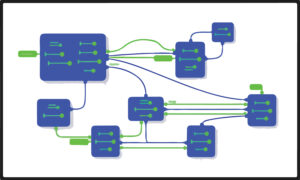
June 1, 2026An illustration of how probabilistic AI can be grounded inside deterministic financial operations

We recently carried out research into the use of artificial intelligence and data analytics within Australia’s major banks — ANZ, CBA, NAB, and Westpac.
This short article in our Distinctive Insights Intelligence Vault series delves into one of the key highlighted themes: Fraud and Financial Crime Prevention.
Our aim in publishing this content is to help finance professionals further understand how artificial intelligence and data analytics are being applied to support key business processes within financial institutions.
In our latest research into the Big Four Australian banks (ANZ, CBA, NAB and Westpac), the theme of fraud and financial crime prevention stood out again and again.
It’s no longer just about monitoring transactions. We’re seeing AI being used to:
From ANZ’s use of Natural Vision Processing to Westpac’s launch of SaferPay, the shift is clear: fraud prevention is getting smarter, faster, and more human-aware.
Let’s talk about how fraud prevention is actually being done — right now — by the Big Four banks.
It’s not just internal innovation. These banks are actively partnering with AI vendors, building real-time analytics layers, and embedding intelligence into the very edges of their customer journeys.
Some highlights from our research:
ANZ deployed over 170 ML algorithms (already by mid-2023) to flag scam flows, block risky transactions, and spot mule accounts. Partnering with IDVerse, they now verify identities using face biometrics and generative AI — built to detect deepfakes and support fairness.
CBA works Quantium Telstra on tools like Scam Indicator and Fraud Indicator.
NAB, CBA and Westpac are part of a cross-bank behavioural biometrics network via BioCatch — using real-time risk scoring based on device movement and human interaction data.
Westpac launched SaferPay, an AI-driven pre-transaction protection layer. It flags suspicious activity before the money even moves.
What ties these together is a shared mindset shift:
→ From reactive defence to anticipatory intelligence
→ From static rule-sets to adaptive, behavioural models
→ From siloed fraud teams to collaborative ecosystems
The Australian banks aren’t just experimenting — they’re scaling these solutions.
From our deep dive, here’s what’s becoming clear:
And perhaps most importantly: The impact is measurable.
This isn’t just about compliance or cost-saving anymore. It’s about trust, identity, and real-time protection at scale.

 Back
Back

An illustration of how probabilistic AI can be grounded inside deterministic financial operations
Follow Distinctive Insights on LinkedIn and receive an invitation to subscribe to our newsletter.