How Can Financial Institutions Ground LLMs for Real Operational Use?
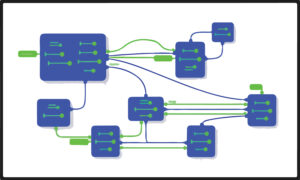
June 1, 2026An illustration of how probabilistic AI can be grounded inside deterministic financial operations

Front offices were among the first parts of the trading lifecycle to experiment with artificial intelligence — from machine learning price predictors to pattern-sensitive execution algos.
Here we look at design decisions for capital markets front offices around how decision logic is wired into trading flows, where intelligence lives relative to OMS/EMS platforms and data fabrics, and how explainability and control are preserved when models operate at market speed.
Industry deployments are starting to show how front office platforms can combine model-driven price indications with execution protocols that rebalance liquidity provision and information sharing across dealers and investors. AI-driven corporate bond venues show examples of machine learning being used to identify liquidity, optimise RFQ protocols, and support price discovery as part of the venue’s core operation.
Treating AI as a peripheral “model box” though underuses its potential. A robust design assumes that data representation and pattern recognition form a continuously updated decision spine, with execution engines consuming these signals through well-defined, monitored interfaces.
Architecturally, this tends to shift signal extraction into shared services that continuously update the trading context. Machine Learning models estimate fair value, liquidity, and impact; LLMs increasingly provide human level access into these signals via natural language.
Solution-specific AI models promise simple deployment, but this can fragment intelligence across products and make it harder to compare behaviours across desks.
Central services — for example, a shared feature store and model layer that serves multiple OMS/EMS instances — support consistency, but introduce new dependencies on data pipelines and internal MLOps capabilities. Recent industry research notes that leading firms are beginning to experiment with such shared AI platforms, especially where they already run consolidated data hubs for risk and P&L.
A pragmatic pattern may be emerging: cross-asset ML models and language models sit in a shared analytics tier that standardises inputs and explanations, while execution platforms retain a degree of local autonomy but consume those signals via APIs.
This arrangement allows firms to reuse intelligence across desks while preserving the low-latency paths often needed for trading.
As AI migrates closer to the order-routing path, supervisors are sharpening expectations around explainability and accountability. Regulators emphasise that AI-driven trading must satisfy existing requirements on governance, testing, and oversight rather than sit in a separate experimental category.
Supervisory bodies and industry groups also warn that over-curtailing AI could paradoxically raise investor risk by depriving markets of better surveillance and risk tools.
Front-office architectures therefore need an explicit “supervisory shell” around AI components. Models should log the data they used and the signals they produced; language models that explain strategy performance or order behaviour must draw on those logs explicitly. Execution components — whether simple algos or more agent-like controllers — should expose parameters and decision rationales that can be reviewed by best-execution committees and model risk teams.
The goal is not to slow systems down to human speed, but to design architectures where human oversight operates on well-structured evidence produced by the models themselves.
Architecting AI-native front offices is fundamentally about placement — deciding which parts of market understanding and execution refinement belong in shared intelligence services, and which should remain close to the execution rails. Over the next few years, regulatory work on AI in capital markets will likely coalesce around expectations for governance, testing, and transparency, not prescriptive technology choices – those will be left to firms to decide for themselves.

 Back
Back

An illustration of how probabilistic AI can be grounded inside deterministic financial operations
Follow Distinctive Insights on LinkedIn and receive an invitation to subscribe to our newsletter.