How Can Financial Institutions Ground LLMs for Real Operational Use?
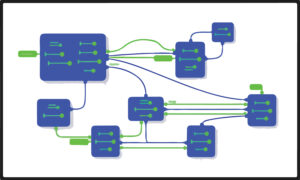
June 1, 2026An illustration of how probabilistic AI can be grounded inside deterministic financial operations

🟩 The Missing Layer in Enterprise AI Adoption
The current market narrative around AI in financial services has evolved rapidly over a short period of time.
When tools like ChatGPT, Claude, Gemini and Copilot became widely available, individuals began experimenting with Generative AI to draft documents, summarise reports, generate ideas and support coding tasks. The emphasis was on personal productivity.
This narrative then shifted toward something more ambitious: agentic AI, autonomous systems and end-to-end orchestration of workflows.
As this shift has taken place, two questions have become increasingly common.
Why have the benefits not yet fully materialised?
Are organisations now waiting for autonomous systems before meaningful value emerges?
Both questions point to the same underlying issue: the transition from individual experimentation to fully autonomous systems skips a critical intermediate step.
Between these two stages sits a more immediate and practical transformation: embedding Generative AI into enterprise workflows.
🟨 Three Stages of Generative AI Adoption
This progression can be understood more clearly by distinguishing between three distinct stages of Generative AI adoption.
Individual Generative AI is where most organisations have already begun. Usage is decentralised, with individuals using tools to draft content, summarise information or generate ideas. The outputs are useful, but they remain isolated. They are not systematically integrated into workflows, data environments or decision processes.
Enterprise Generative AI represents a fundamentally different operating model. It is not defined by the use of models, but by how those models are integrated into operational systems and processes.
In practical terms, Enterprise Generative AI means:
In this model, AI is not a tool used by individuals. It becomes part of the system through which work is executed. Within investment workflows, this means AI outputs can feed directly into activities such as research, signal generation, portfolio construction and monitoring.
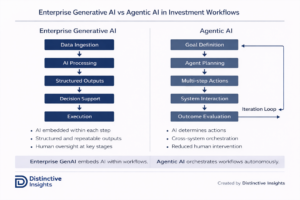
Agentic AI introduces a different concept altogether. Rather than integrating AI into defined workflows, agentic systems are designed to initiate, plan and execute actions across multiple steps and systems with a degree of autonomy.
This creates a fundamentally different set of requirements. Agentic systems must determine what actions to take, sequence those actions, interact with multiple systems, and operate with limited human intervention. While this offers significant potential, it also introduces challenges around control, reliability and governance.
This progression can be visualised within the context of front office investment workflows.
🟦 Where the Value Actually Comes From
The limited impact observed so far is not a failure of the technology. It reflects the gap between individual usage and enterprise deployment.
The constraint is not model capability, but system integration.
When Generative AI is used at the individual level, outputs remain disconnected from the systems where decisions are made and actions are taken. Insights are generated, but they are not systematically captured, standardised or reused.
Enterprise Generative AI changes this by making outputs a defined part of the workflow itself.
Instead of producing unstructured responses, systems generate outputs in consistent formats – signals, classifications, summaries or structured data – that can be consumed by other systems. These outputs can then feed directly into analytical processes, decision frameworks and operational tools.
Within investment workflows, this means that outputs are not just informational, but operational. Research outputs can be structured into signals, signals can feed into portfolio construction, and monitoring outputs can update risk and performance processes.
This is where value begins to scale. The focus shifts from improving how individuals work to transforming how workflows operate.
🟪 A Practical Illustration – Investment Management Workflows
The distinction becomes clearer when viewed across the full front office investment workflow.
In institutional investment management, this typically involves a sequence of activities: ingesting information, analysing that information, generating signals, supporting portfolio decisions and monitoring outcomes.
In a traditional model, these steps are fragmented. Data is gathered from multiple sources, analysis is performed periodically, and outputs are distributed across systems in a largely unstructured form.
At the individual level, Generative AI can improve parts of this process. Analysts can summarise research more quickly or extract insights from large volumes of information. However, these outputs remain informal and are not consistently integrated into downstream processes.
Enterprise Generative AI changes this by embedding AI directly into each stage of the workflow.
Information ingestion becomes continuous, with AI systems processing large volumes of structured and unstructured data in a consistent manner. Analytical outputs are generated in defined formats – for example, classifications, signals or standardised summaries – that can be consumed by other systems.
For example, earnings call transcripts can be processed into sentiment signals that feed directly into portfolio monitoring processes.
These outputs are then integrated into connected systems. Signals can feed into portfolio construction tools, and monitoring outputs can update risk and performance processes. The same logic is applied consistently across users, making the workflow repeatable rather than dependent on individual interpretation.
In this model, AI is not determining what actions to take or orchestrating the workflow. It is embedded within a defined process, producing structured outputs that support decision-making at each stage.
In this model, intelligence is embedded within each stage of the workflow, supporting decision-making without replacing it. By contrast, agentic approaches aim to direct and coordinate the workflow itself.
🟫 What This Requires in Practice
Moving from individual usage to Enterprise Generative AI requires a shift from tools to systems.
The focus is no longer on what models can produce in isolation, but on how outputs are generated, structured and integrated within operational workflows.
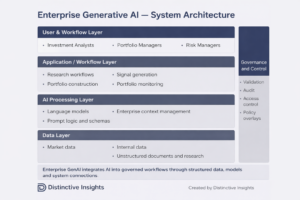
This requires a set of coordinated capabilities that enable AI to function as part of the workflow rather than alongside it.
These capabilities typically include:
These elements do not operate independently. They form an interconnected system that determines whether AI outputs remain isolated or become operational.
Without this foundation, Generative AI remains at the level of individual productivity. With it, AI becomes part of the execution layer of the organisation.
These capabilities can be understood as a coordinated system of components that enable AI to operate within enterprise workflows.
🟩 A Structural Shift Already Underway
The transition to Enterprise Generative AI is not theoretical. It is already beginning to reshape how workflows are designed and executed across financial services.
As organisations move beyond individual usage, the focus is shifting toward integrating AI directly within operational processes. Data flows are becoming more continuous, outputs more structured, and workflows more tightly connected to the systems in which decisions are made.
This shift is not defined by isolated use cases, but by how processes are being reconfigured to incorporate AI at each stage of execution.
In this context, the distinction between individual usage, enterprise integration and agentic orchestration becomes more than conceptual. It reflects different ways in which work is structured, controlled and executed.
The immediate transformation is not the replacement of workflows, but their reconfiguration – embedding intelligence within existing processes to improve how decisions are made and actions are taken.

 Back
Back

An illustration of how probabilistic AI can be grounded inside deterministic financial operations
Follow Distinctive Insights on LinkedIn and receive an invitation to subscribe to our newsletter.