How Can Financial Institutions Ground LLMs for Real Operational Use?
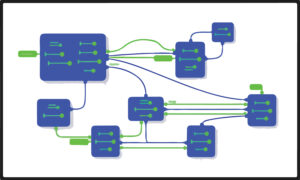
June 1, 2026An illustration of how probabilistic AI can be grounded inside deterministic financial operations

🟨 In Summary
🟦 Why AI Adoption Surveys Don’t Reflect Reality in Financial Services
There is often a disconnect in how AI adoption in financial services is described in industry survey findings.
Such surveys consistently report high levels of AI uptake. Most suggest that a clear majority of financial firms are already using AI in some form, with rapid expansion expected over the next 12–24 months.
At the same time, many of these surveys indicate that material returns on investment remain limited or are yet to be realised at scale. In many respects, this finding aligns more closely with the day-to-day experience of staff inside financial institutions.
In practice, AI usage remains uneven across institutions. It is typically driven by individual user experimentation and is often concentrated in specific functions and use cases. Core workflows, in many areas, continue to operate largely as before, with limited evidence of systematic redesign or end-to-end integration. While there are clear examples of meaningful progress, these tend to be localised rather than indicative of broad, embedded transformation.
This apparent tension is not contradictory. Rather, it reflects a difference between what surveys capture and what they are often assumed to represent. Survey findings are not inherently inaccurate, but they frequently measure aspects of AI activity that do not directly correspond to deeply embedded operational change.
🟦 The Problem with “Adoption” as a Survey Measure
Most surveys reduce AI deployment to a single concept: adoption.
However, AI is not a binary state. It is not something an organisation simply “has” or “does not have”.
In practice, AI deployment is multi-dimensional. It depends on:
When these dimensions are compressed into a single metric, the result is inevitably misleading.
Two firms can both report that they have “adopted AI” while operating at fundamentally different levels of maturity.
🟪 Dimension 1 – What Is Being Used: Conflating Different Types of AI
The first source of distortion arises from how surveys define “AI”.
In practice, the term covers a wide range of capabilities, including:
These technologies differ significantly in terms of complexity, risk, and their potential to transform workflows.
However, surveys often group them together under a single category of “AI use”. As a result, fundamentally different types of capability are treated as equivalent, regardless of how they are applied or the role they play within the organisation.
This creates a form of false equivalence. The presence of assistive tools, such as drafting or summarisation systems, is frequently interpreted in the same way as more advanced forms of deployment, such as predictive modelling, decision support, or workflow automation.
In practice, these represent very different stages of capability and have materially different implications for how work is performed.
🟪 Dimension 2 – Where AI Is Used: Collapsing Uneven Reality
AI adoption within financial institutions is not uniform. It tends to concentrate in specific areas such as:
These functions offer structured data, repeatable processes, and clearer risk boundaries – making them more suitable for early deployment.
Other areas, particularly those involving complex decision-making or transactional impact, often lag behind.
This reflects a question of where AI is actually used across the organisation.
Many surveys do capture this distribution at the level of individual functions or use cases. However, this granularity is often lost when findings are aggregated and translated into an overall narrative. Responses are typically synthesised into a single institutional view – for example, that “the organisation uses AI” – which obscures the underlying pattern of deployment.
As a result, AI may be presented as broadly adopted, even when it remains concentrated in a limited number of functions. What appears as widespread adoption at the headline level is often the result of a collection of localised deployments.
🟪 Dimension 3 – How Deeply AI Is Embedded: Treating Light Usage as Adoption
A further issue is how usage is interpreted.
Much of the current wave of AI activity is assistive:
These use cases can deliver genuine productivity gains. But they do not fundamentally alter the structure of work.
They sit alongside existing workflows, rather than reshaping them.
This reflects the depth to which AI is embedded in workflows.
This is very different from:
However, surveys often group these different forms of activity under a single category of “AI use”. As a result, light, user-initiated activity is frequently interpreted as meaningful deployment, when in practice it typically represents an early stage of adoption rather than a mature or embedded state.
🟨 Cross-Cutting Distortion – Mixing Current State with Future Expectations
Many surveys combine into a single narrative:
Respondents may report:
But when these are presented together, they create an impression of maturity that does not yet exist.
This distorts the relationship between current deployment and the outcomes it can realistically produce.
This is particularly visible in areas such as:
The direction of travel is clear, but the current state of deployment is often less advanced than the narrative suggests.
🟦 What Surveys Actually Tell Us
Industry surveys do provide valuable insight.
They consistently indicate that AI is now present in most financial institutions, that experimentation is widespread, and that usage is expanding beyond isolated pilots. They also suggest that productivity gains are beginning to emerge, particularly in areas where AI is applied to structured, repeatable tasks.
At the same time, surveys highlight a set of persistent challenges, including the transition from pilot to production, the integration of AI into core systems, the management of governance and risk, and the development of appropriate data and infrastructure capabilities.
In this sense, survey findings are directionally accurate. However, they primarily capture the presence and expansion of AI activity, rather than the depth of its integration into day-to-day operations.
⬛ Closing Thought
The disconnect between survey findings and day-to-day experience is not a contradiction, but a reflection of how AI adoption is currently evolving within financial services.
Technological capability is advancing rapidly, and the range of potential use cases continues to expand. However, the process of embedding these capabilities into regulated, complex operating environments is inherently slower and more uneven.
Surveys tend to capture the expansion of capability and activity. Day-to-day experience reflects the extent to which those capabilities have been integrated into real workflows.
Understanding the distinction between the two is essential for interpreting the current state of AI adoption in the industry.

 Back
Back

An illustration of how probabilistic AI can be grounded inside deterministic financial operations
Follow Distinctive Insights on LinkedIn and receive an invitation to subscribe to our newsletter.